Mostrando entradas con la etiqueta Walkability. Mostrar todas las entradas

miércoles, 20 de julio de 2011

La calle educa: pasos de cebra // guerrilla urbana


Tomado de: PLATAFORMA URBANA


En el mundo cerca de 500.000 peatones mueren al año en accidentes de tránsito. Sólo en Chile mueren 900 cada año, 50% de ellas en vías urbanas.  Aunque un gran número de muertes por atropello se produce por exceso de velocidad de los automovilistas que pierden el control, otro gran número de muertes se produce por cruzar la calle en lugares prohibidos y no usar los pasos de cebra.
Curitiba es uno de los buenos ejemplos que tiene Sudamérica como modelo de ciudad. De ahí que siempre lidere los índices de calidad de vida y sustentabilidad en la región.
No es de extrañar que  las autoridades de esta ciudad estén constantemente haciendo campañas en favor de una ciudad más segura y con mejor calidad de vida para sus habitantes.
El siguiente es un buen ejemplo de eso:
Como una forma de llamar la atención y crear conciencia entre los peatones, para que estos crucen la calle por los paso de cebra, las autoridades de Curitiba decidieron hacer una campaña en la que contrataron artistas locales para que pintaran estos pasos.

En este video se puede ver el resultado de esta intervención urbana:


Pero Curitiba no es el único lugar donde se han hecho campañas de este tipo. Aquí otros buenos ejemplos en otras ciudades que han realizado interesantes campañas para incentivar el uso del paso de cebra.


Los objetivos de laChina Environmental Protection Foundation con esta campaña eran dos: Por un lado hacer que los peatones cruzaran por el paso de cebra y por otro desincentivar el uso del automóvil. La idea era que con cada paso los peatones fueran dandole “vida” a este árbol.

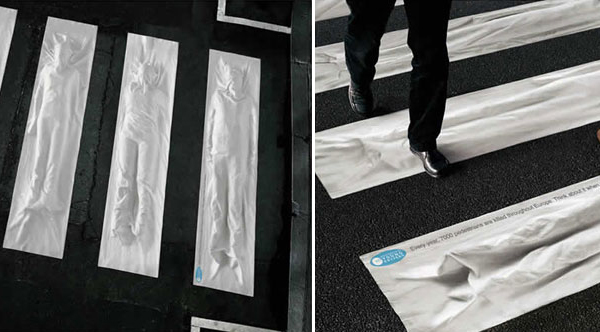
“Cada año mueren 7.000 peatones en Europa” Es lo que decían estos pasos de cebra en París, que tenía por objetivo conscientizar a los traseuntes, pero también fomentar el manejo responsable.

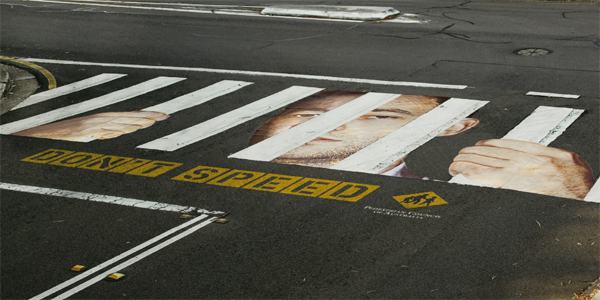
Esta campaña australiana está dirigida a los automovilistas, para que éstos reduzcan la velocidad cuando se están acercando a un paso de cebra, amenazándolos directamente con que el exceso de velocidad los puede llevar a la cárcel.

martes, 2 de febrero de 2010

Articulo: Packed Streets Have a City of Walkers Looking Skyward for Answers

MUMBAI—Mumbai's muddled streets are too packed to walk through, so India's commercial capital has come up with a solution. Uplift the masses—not in some fuzzy metaphysical way, but on "skywalks" made of steel.

Skywalks, India's Sidewalks in the Sky

2:39

The streets in the crowded megacity of Mumbai are running out of space for pedestrians, so the city has come up with a lofty solution: Elevated skywalks. WSJ's Eric Bellman reports.

Most streets here have no footpaths. The sidewalks that do exist are bursting from a gridlock of walkers, street vendors and squatters. The scrum has become even pushier recently as hundreds of thousands migrate to this city of nearly 18 million people for jobs created by its economic expansion. Success has also led to an unprecedented number of cars and motorcycles on the road.

To lift the pedestrians that power this city above the fray, Mumbai is building more than 50 elevated walkways. The skywalks will sprout from train stations across the city and snake over the traffic for up to two miles to create a pedestrian express lane.

Shubhangi Ambardekar, a 47-year-old bank employee, used to splurge on an auto rickshaw every workday to avoid the mess on the roads around Bandra train station in central Mumbai. Rickshaws don't like taking such short trips so she would often have to wait 20 minutes before one would take her. Today she uses the new Bandra Station skywalk, strolling two floors above the cacophony. She saves the fare and arrives at work relaxed.

Mumbai Pedestrians to Get Raised Paths

Michael Rubenstein for The Wall Street Journal

Pedestrians walk to work on a skywalk connecting the Bandra train station and the Bandra Kurla Complex in Mumbai last month.

"There's security, it's clean and we get fresh air too," she said on a walk home from work.

The skywalk Ms. Ambardekar uses was the first the city finished last year. Locals have dubbed the bright, twisting structure the "Yellow Caterpillar." At a height of around 20 feet, it meanders for around a mile, delivering commuters to one of Mumbai's many new office parks.

The fate of the city's foot soldiers is crucial because close to 60% of the trips made here are on foot. That makes this one of the most pedestrian-powered metropolises in the world. Until now, however, pedestrians have been largely ignored.

Some Mumbaikars, as citizens are known, aren't happy. Retailers say they are losing business while residents say skywalks block views, allow pedestrians to peek into private homes and are just as likely to be taken over by homeless families and shopless vendors as the sidewalks.

"Whether you have skywalks or not, the problems will remain the same," says Ashok Ravat, head of the Mahim Skywalk Protest Committee, which was created to block a long skywalk scheduled to twist through his neighborhood in central Mumbai. "This is another huge mistake."

Still, something had to be done, city planners say. The road under the Yellow Caterpillar, like station roads across the city, is an obstacle course through a minefield. Commuters spill down the Bandra Station steps and into a knot of three-wheeled auto rickshaws, buses and trucks on the street below. The closest thing to a sidewalk here is a patch of dirt next to a crud-filled creek. Hundreds of commuters walk in the street, dodging vehicles as they go.

Sidewalk Squeeze

See what's squeezing the sidewalk around Mahim.

On the way to the nearby business park—home of Citigroup's main India office and the National Stock Exchange—they pass through a slum. The roadside is occupied by small shops, families living in plastic-tarp homes, parked motorcycles and goats rooting through garbage. The tiny stretch of sidewalk that eventually emerges about five blocks from the station is cut short by the fence of a small neighborhood police station built directly on top of it.

Then pedestrians have to find their way across an off-ramp of Mumbai's busiest highway. There is a functioning traffic signal and even a policeman at the corner, but drivers often ignore both.

The obvious solution of widening the sidewalks just isn't an option. Mumbai, formerly known as Bombay, is a thin spit of land bound on three sides by the Arabian Sea. Moving buildings to widen roads is next to impossible thanks to tough tenancy laws. Courts and politicians sensitive to the needs of the micro-entrepreneur make it difficult to move illegal street vendors.

"We clear them and they just come back," says Ashwini Bhide, joint metropolitan commissioner of the Mumbai Municipal Regional Development Authority. "That's why we thought, 'Let's create some additional space on the road by going elevated.' "

Skywalks are quick to build, relatively inexpensive and only require land the city already controls. The projected bill for the 50-plus skywalks is around $300 million. The city expects to recover most of that cost by selling advertising space on them.

While Hong Kong has a network of elevated walkways and Minnesota has its "skyway" system to shelter commuters from harsh winters, Mumbai city planners say they came up with this idea on their own.

[SKYWALK]

A MUMBAI SKYWALK

"It was a local solution for a local problem," says Ms. Bhide. "Because of a paucity of space and such a short supply of land there is no other alternative."

Building the perfect skywalk, however, hasn't been easy. While the walkways run over government roads, there still often isn't space on the ground to plant enough supporting columns. Longer stretches between columns mean the city has to spend more on stronger, lighter materials and thicker columns. Commuters found the early skywalks too boxy and bright, so new ones use curved roofs, dark colors and chrome.

When engineers started digging to build the foundations, they found the chaos on the street continues underground. A few feet down, they ran into uncharted water, electricity and phone lines as well as sewers, forcing them to redesign whole skywalks. Trying to get the city water authorities or state-run telephone company to shift infrastructure would take too long.

Engineering difficulties and neighborhood opposition have blocked six planned skywalks and could stop more, city planners say. But they will continue building them because the streets are getting worse everyday. The city has hired armed guards to keep skywalks clear and the response from commuters has been largely positive.

Ms. Ambardekar, the commuter, uses her neighborhood skywalk even on her days off.

"Our city is so crowded we don't have a place to walk or exercise," she says. "My friend and I come up to the skywalk for our evening walks."

—Arlene Chang contributed to this article.

Write to Eric Bellman at eric.bellman@wsj.com


http://online.wsj.com

jueves, 14 de enero de 2010

Articulo: LEED Home Award Winners are Walkscore FAIL

LEED award housing photos keesler
The Keesler Air Force Base project in Biloxi, Miss., by Hunt Yates currently has 792 registered single-family homes pursuing LEED for Homes certification, making it the largest LEED-certified project in the nation and the first Air Force installation to have LEED-certified homes.

I have been gearing up to do a rant about the 2009 LEED for homes award winners. They are, with an exception or two, extraordinarily silly; Steve Mouzon wrote on the Original Green that "I've gotta confess that when I first saw some of these, I checked the calendar to make sure it wasn't April Fool's Day." Like Steve, I was going to look at each of the houses, but over at NRDC, Switchboard, Kaid Benfield did it by the numbers- he Walkscored them.

Walkscore is a terrific tool; the New York Times just wrote about how it is a good indicator of real estate value. TreeHugger has noted that walkable cities are the fittest,and that "a walkable community promotes better health, reduction in greenhouse gases, more transportation options, increased social capital and stronger local businesses." Kaid notes that the opposite is also true:

The added environmental benefit of the residences' laudable green features will be offset by the environmental damage caused by the sites' automobile dependence, poor environment for walking, and relative distance from jobs, shops and services.

The results of the walkscore range from the laughable:

LEED award housing photos habitat house
Central Oklahoma Habitat for Humanity's Hope Crossing is a 59-acre affordable-housing development that once completed will be the largest LEED-certified Habitat for Humanity community in the U.S. OG&E, the local energy utility, donated energy-efficient windows, foam insulation, and compact fluorescent lights and ClimateMaster donated geothermal systems for each unit to help achieve an expected 50% reduction in monthly energy bills.

This charmer built by Habitat for Humanity, with a snout garage that I thought was almost illegal everywhere now, got the extraordinary walkscore of 3. ("Car-Dependent/Driving Only: Virtually no neighborhood destinations within walking range. You can walk from your house to your car")

LEED award housing photos habitat house site

So for the poor recipient of the Habitat for Humanity house in the middle of nowhere, do they give them a minivan as well as a house?

LEED award housing photos ville trieste

Or how about Pulte Homes' Villa Trieste development in Las Vegas, which has "a roof-integrated solar-electric power system and a wall-mounted touchscreen connected to an energy meter to allow homeowners to see how much energy they are generating and using in real time."

LEED award housing photos ville trieste site

It gets a walkscore of 38. ("Car-Dependent: Only a few destinations are within easy walking range. For most errands, driving or public transportation is a must") - the nearest bus stop is over half a mile away.

Kaid looks at the reason location seems to get so little attention as an issue.

The usual arguments in favor of continuing to give location such short shrift are (1) to transform the market, we must meet the market where it is, not where we wish it were, and (2) "but the architect/builder/engineer doesn't choose the site." I'm not persuaded by either. On the subject of market transformation, building site choices are part of the market that must be transformed. We must reward those who make the right choices for the environment much more than we reward those who don't. Besides, the market has changed already, so that these award winners are much less representative of the housing market as a whole than they used to be.

I agree with Kaid's conclusion that LEED and the Green Building Council have done great work, and that they are inspiring architects, builders and the public to expect more. But I also agree with his last line:

It is time to be much more candid to ourselves, the public, and policy makers about the environmental damage done by even good buildings in bad or mediocre locations, and to start doing something about it.

http://www.treehugger.com/

martes, 20 de octubre de 2009

Articulo: A Place Is Better Than a Plan

A Place Is Better Than a Plan
Revitalizing urban areas is best done through small improvements, not grand designs.
19 October 2009
The importance of small ideas to urban revitalization isn’t widely appreciated. Particularly in the most recent real-estate cycle, many planners, design professionals, and developers produced grand schemes instead. But profound change is more likely to result from a deeply considered idea that alters an essential component of an urban environment than from an elaborate master plan that requires abundant resources and considerable political capital. While some large-scale plans, like Rockefeller Center, are successful, most become impersonal, overbearing failures—or, even more often, are stillborn, the victims of the long process of assemblage, environmental remediation, community participation, zoning adoption, and the securing of financing.

For a striking example of the power of an apparently small idea, consider urbanist William H. Whyte’s suggestion that in public spaces, people prefer movable chairs to fixed seating. People like to control their own space, and movable chairs allow them to do just that. Movable chairs let people face one another and interact in different ways, not just the ones that landscape designers have in mind when they arrange fixed furniture. Having chairs scattered around sends a message of trust that people won’t steal them. And chairs’ historical associations convey the sense that a space is civilized and of high quality—like the European areas that use them, such as the Luxembourg Gardens in Paris.

Whyte first suggested movable chairs for Paley Park, a small park in Manhattan’s high-end Plaza District. After their success there, he recommended that they be a key element in the restoration of squalid Bryant Park during the 1980s. Some regarded that suggestion as naive; failing to tie down chairs amid the bustle and grunge of 42nd Street would surely spell trouble, they said. But the chairs—the same model used in the Luxembourg Gardens—were a key element of Bryant Park’s hugely successful reintroduction in 1992. One now finds movable chairs in public spaces across the country; in fact, many designers have chosen the same $30 chair that Bryant Park uses, apparently finding in its design something essential to its success. Most recently, movable chairs can be found in the recaptured pedestrian spaces in Times Square, though they are slightly different models.

Another small idea that produced an outsize effect in improving public places was the high-quality trash-can design employed in 1993 by the Grand Central and 34th Street Business Improvement Districts, which were run by the same staff as the Bryant Park Restoration Corporation. The idea of a well-designed trash can was unusual at the time; the Gotham standard was made of battered metal mesh. But an attractive trash can sends a powerful message that public spaces are well maintained and under social control, and as a result of its successful implementation in midtown Manhattan, communities across the country and in Europe have adopted the very same design. Other widely emulated ideas that grew out of the work of the Bryant Park Restoration Corporation and its affiliates include showing films in public spaces, using streetlamps that emit high-quality white light (as opposed to high-pressure sodium lamps’ yellow light), and planting gardens to soften streetscapes.

Campus Martius Park in Detroit is a dramatic example of how the Bryant Park model has been adopted elsewhere. Detroit is a museum of failed, expensive, large-scale urban fixes that were à la mode in planning circles at different times over the past half-century: a decrepit and underused people mover, the gigantic and isolated Renaissance Center, and the equally huge and isolated Comerica Park (sometimes derided as Comerica National Park), where the Detroit Tigers play. The stadium looks like a spaceship that descended on the city after the surrounding blocks were leveled and turned into parking lots. Campus Martius, by contrast, is Detroit’s liveliest and most humane public space. Based on Bryant Park, it is tremendously popular with pedestrians. The park includes movable chairs, a fountain, food concessions, regular arts programming, and high-quality horticulture.

Of course, urban planners are perfectly capable of ignoring the proven place-making techniques of the last 15 years. The park built atop Boston’s Big Dig, after the expenditure of billions of dollars, is a hot, forbidding wasteland on a spring day. There is nothing to draw visitors in: it contains limited, fixed seating, has no shade or water, and appears unprogrammed. While from a distance (and perhaps from an airplane) its design is attractive, from a pedestrian’s perspective it is cold and uninviting. When I visited this past spring, it was essentially empty, while adjacent attractions like the Quincy Market bustled with visitors.

Small changes are appealing for many reasons. They’re cheap, for one thing. Also, what works can be easily expanded, and what doesn’t work can be as easily terminated or altered. One successful food concession can become two; an unsuccessful stall selling local crafts can be replaced; a planter made from a material that discolors or chips can be replaced with a better one. Contrast that with grand schemes, which can attract broad opposition and be subject to complex political, logistical, and financial obstacles. Once an elaborate design has been committed to, backing away from it—or even altering it—becomes both politically and mechanically complicated. Further, planners have a limited capacity to predict how people will respond to their designs. The larger the project, the more likely unintended consequences become, and the more difficult it is to change course.

Above all, small ideas for revitalizing urban areas work, as the success of Bryant Park and its emulators has demonstrated. Why? Because, as Whyte (and Jane Jacobs as well) understood, people in public spaces respond to thousands of subtle visual and aural cues, and successful places manipulate these cues (often without premeditation) to provide familiar assurances of comfort and well-being. The cues prompt a person who encounters a new place to predict a positive experience there—above all, that he will be safe. The most important cues transmit a sense of order and social control. And the best new or restored spaces, like Bryant Park, Campus Martius, Discovery Green in Houston, and most recently the High Line park on Manhattan’s West Side, provide their patrons with the premonition of an enjoyable experience.

Those engaged in the work of downtown renewal and urban revitalization should always remember that truth. It will help them identify, and integrate into their projects, the helpful small ideas that can make cities more enjoyable places.

Andrew M. Manshel is executive vice president of the Greater Jamaica Development Corporation and was previously the general counsel of Bryant Park Restoration Corporation/Grand Central Partnership/34th Street Partnership. He is a director and the treasurer of Project for Public Spaces.

miércoles, 14 de octubre de 2009

Video: Learning to Walk in Arequipa, Peru


Mercaderes Street, Arequipa, Peru from EMBARQ Network on Vimeo.


Como la Ciudad de Arequipa resolvio muchos de los problemas que presenta Caracas, dandole prioridad al Peaton.

Sin embargo, el tema de la seguridad y control es clave. Asi como es le dan prioridad al peaton ante el trafico, tambien lo es ante los buhoneros, motorizados, etc.. Como es el caso de Sabana Grande por ejemplo.