lunes, 2 de noviembre de 2009

Articulo: Rea Vaya ("We are Moving") In South Africa

Rea Vaya ("We are Moving") In South Africa

Todd Litman
Mon, 10/26/2009 - 05:22
Tagged: Africa BRT Bus Rapid Transit International Development Public Transportation Transportation
To celebrate an important victory a winning team sometimes parades around the arena with their coach on their shoulders as the fans cheer in adulation. Planners sometimes deserve similar treatment! For example, regardless of who wins the 2010 FIFA World Cup to be held in South Africa June and July 2010, the real victor will be residents of the four cities where matches will be held, who gain an efficient new public transportation system as a long-term legacy. Everybody wins!


Rea Vaya

The Rea Vaya (“We are Moving”) Bus Rapid Transit (BRT) system began operation last month with service between Johannesburg and the Soweto township. This is a significant milestone in the development of high quality, affordable transport in Africa. Rea Vaya is the continent's first full BRT system. Although it has its share of initial teething problems, the results are fantastic. Users are delighted with Rea Vaya.
Rea Vaya can help change transportaiton trends in Africa.


This first route currently averages a respectable 12,000 to 16,000 daily passengers, and even off-peak runs are often crowded. Ridership is expected to increase substantially as the network expands and incorporates features such as express service that further reduces travel times. The Port Elizabeth and Cape Town systems will also be operating soon. The Tshwane (Pretoria) system was delayed but construction is about to begin.


Rea Vaya uses high capacity buses on their own right-of-way with comfortable and secure stations.


It is difficult to convey the magnitude of this accomplishment. Previously, low-income commuters were forced to use crowded, dangerous, unreliable and costly private minivans, called taxis. In contrast, the new BRT systems offer world-class service. Spacious vehicles provide fast and reliable transport from early morning until late at night. Stations are clean and bright, and employees treat passengers with respect. Other African cities now have an example to follow.

The project faced huge obstacles, including complex political dynamics. In particular, the taxi industry, known for violence, opposes the project, fearing job losses. Their fears are actually misplaced, former taxi drivers are being integrated into the BRT system as bus operators where they have better working conditions, more job security and more opportunities for advancement. There are still conflicts, the first day of Rea Vaya operation somebody (assumedly taxi drivers) shot at one of the buses, injuring two passengers, but service has continued with no subsequent attacks. Security teams are visible throughout the system, and it is safer than the existing minibuses, which have frequent crashes and incidences of violence. BRT cannot serve every route so there will continue to be a role for the private operators, but they will need to improve their service quality to stay competitive.

This project will help inspire more sustainable transportation throughout Africa. Because existing public transport service is poor, residents tend to purchase a car and abandon the public transport system as soon as they can, despite large direct and indirect costs. As a result, traffic is congested, traffic fatality rates are high, and these countries devote a large and growing portion of their wealth to importing vehicles and fuel, displacing investments that can improve productivity and provide badly needed services such as medical care.

This project has special meaning to many of us who care about progress and equity in lower-income regions. Years ago the Soweto township was a center of anti-apartheid resistance, including an uprising and government massacre in 1976. Fortunately, South Africa has progressed since. It is now multi-racial and developing rapidly, but still greatly burdened by a legacy of physical segregation and underdevelopment of Black African communities. These communities desperately need respect, security and economic opportunity. BRT provides tangible progress for township residents. This is an example when basic infrastructure improvements provide many layers of benefit.

I am proud of having made a small contribution to this project. I visited South Africa in 2006 and gave presentations to planners and public officials on transport policy innovations. The star of the tour was Lloyd Wright of Viva Cities, a tireless advocate of sustainable transportation who literally wrote the book on BRT planning. He convinced the mayors of the four major cities that BRT was the only practical way that South Africa could provide efficient mobility during the 2010 World Cup. Lloyd spent much of the last two years in South Africa working to keep the projects on track. The result of his efforts will be much more than just a well-run soccer match; these projects will leave a lasting legacy of betterment.

A soccer team’s success depends on good coaching: thoughtful, methodical, tedious background work and countless well-made decisions which create the environment in which individual players can perform efficiently. That sounds a lot like good planning. The many people working now to implement BRT in South Africa are true planning heroes!

ARTiculo: What Jane Jacobs Can Teach Us About the Economy

What Jane Jacobs Can Teach Us About the Economy


Jane Jacobs, urbanist, writer and activist, is best known for "The Death and Life of Great American Cities." The lessons of her books are still relevant today.

How is that economic stimulus package working for you? Think TARP was worth those billions? Perhaps our financial system is back from the brink, but just how far — or how long until we're staring down that same precipice — is not clear. Aside from healthy investment-house bonuses and the fact that General Motors still exists, most have seen little change. While our financial pundits are still scratching their heads over why our financial structure plummeted so spectacularly let alone what to do about it, many economic thinkers are turning to urban pioneer Jane Jacobs.
Who?
Most know Jane Jacobs as the ultimate champion of cities, who stood up against neighborhood demolition and saw a vibrant ballet where others saw urban squalor. But three years since her death — and a year into a downturn marked by bailouts, foreclosures and sky-high unemployment — her economic vision has come into the spotlight.
"People in economic policy and development are looking carefully at Jacobs' work," says David Boyle, an author and researcher at the New Economics Foundation, a London-based independent economic think tank. "She's been very influential, but subtly so. People aren't always aware of where the ideas come from. This is true from the right and left."
In the landmark The Death and Life of Great American Cities, Jacobs called out the folly of urban "improvement" projects that left city districts barren. (Who guessed that people liked to see their neighbors, and that vacant courtyards and hallways invited crime?) In the same way, her 1984 book, Cities and the Wealth of Nations, zeroes in on how well-intended subsidies can deplete growth and block innovation. Wealth, she argues, is not merely a matter of assets but rather the capacity to 1) engage those assets in production and 2) adapt to changing circumstances and needs.
According to Jacobs, the engine of economic life is "import-replacement." What this somewhat clunky term means is making the products you have been buying. For example, much of New England, where I live, is rich in hardwood forest. But there is no large-scale furniture manufacturing here. Aside from what a few artisans produce for a mostly upscale market, it's imported: Our tables, chairs and bed frames are made from fast-growing trees in Southeast Asia, shipped over and stained to look like oak, maple or cherry. If made here, we'd no longer be dependent on furniture from elsewhere; workers here would apply their own innovations to create their own products and techniques and we'd have more products to trade with other places.
This process, replicated over and over and on a large or small scale, invigorates the economy. Workers gain skills, capital gets invested in new equipment, trading partners emerge, consumer taste gets more sophisticated, etc.
This does not happen when a large corporation plunks a factory down in a derelict neighborhood or rural outpost. But that has been the favored approach to perk up an area's economy. The upshot is that the population becomes reliant on one industry that may not be appropriate for the setting. Supplies get shipped in from elsewhere and other wealth-producing activity languishes.
"Jacobs pointed out that to boost an area's economy, the normal plan is to bring in a branch of some big business. But then you have an industry without roots. They're not using local accountants and local printers," says Susan Witt, executive director of the E.F. Schumacher Society in Great Barrington, Mass., which, since its inception in 1980, maintained a close working relationship with Jane Jacobs. "It's through those roots that you get the economic multiplier effect of small businesses. And a branch or factory based elsewhere can leave as easily as it arrived."
Michael Shuman, research and public policy director of the Business Alliance for Local Living Economies, says research suggests that subsidies to attract and retain development are not effective at jumpstarting economies. One unpublished study he led recently looked at the three largest economic development programs in 15 states and found that fewer than 10 percent of companies involved devoted even a small majority of expenditures to local businesses; in most cases 90 percent of the money spent went out of state.
"The economic developers I speak to no longer even try to defend these subsidy strategies," Shuman says. "They've run out of excuses except for the fact that the politicians like them. Politicians get more mileage from one big deal that brings 1,000 jobs than an entrepreneurship program that generates 10 jobs in 100 local businesses. Even when the rhetoric has shifted to the importance of local, in terms of where the money goes, it's still following an old and entirely discredited mode of economic development."
As for the stimulus bill, Shuman says it has "the worst features of economic development on steroids. If in a typical year, millions [are] spent on pork, this year more than a trillion is spent on pork." Even if the stimulus package is a success, he says, the program "could have been more successful with less money if we had followed Jane Jacobs' ideas" of local resilience through import-replacement.
She wasn't omniscient, and her modern acolytes aren't claiming that. "Where was Jane Jacobs wrong?" Shuman asked. "What she didn't anticipate was the Internet. The argument that cities were the only important economic engines is weakened considerably by Web-based businesses, which have diversified and strengthened rural economies. Another thing she didn't entirely anticipate was climate change, which makes trade as a tool of growth a little more suspect."

Cities and the Wealth of Nations came out 25 years ago. But the dynamics described are eerily familiar. Take, for instance, what Jacobs called "transactions of decline" — trade encouraged to prop up the economy. An example she uses is ongoing, entrenched military production. This appears productive, but it sucks the oxygen out of the economy. Innovation and entrepreneurship (import-replacing processes) slow down, there's less inter-city trade to spark new products and ideas, and the economy loses complexity and the ability to adapt. Entire regions become dependent on military spending; they need a war for growth to occur.
The real estate market crash followed a similar trajectory, says Sanford Ikeda, associate professor of economics at SUNY Purchase. "Look at all the incentives in the run-up to the bubble," he says. "People were encouraged to take more risk than optimal, and [many were] making money on unproductive transfers. Not only is this not productive, but it's an obstacle to growth."
One could look at the derivatives market in the same way, as all the entrepreneurial energy goes into the transactions themselves rather than productivity.
The economic downturn has prompted many to question assumptions about growth. "There is a new focus on what happens on the local level, on import-replacement businesses and what it takes to encourage them," says Schumacher's Witt. "Chambers of commerce are putting more into networking and training for small businesses. There's less talk of tax incentives. These are all Jane Jacobs concepts."
Judy Wicks, founder of the White Dog Café in Philadelphia, and the founder and chairman of the Business Alliance for Local Living Economies, says her business decisions have been informed by Jacobs' economic vision. "I took seriously the notion of 'local supplies with local labor for local consumption,'" she says. "I asked, 'What are we importing that we can make locally?' That's what builds community wealth. Instead of starting another White Dog in another location, I started a Black Cat because there was no store nearby that focused on locally made and fair-trade products."
Jane Jacobs was an advocate of decentralization; her belief that economies function on a regional, as opposed to national, level has helped spur recent interest in launching local currencies.
But her suspicion of bigness was pragmatic rather than ideological: In her view, the larger and more complex the institution or economy, the less accurate the feedback it provides. And accurate feedback is crucial for a system to self-correct. One way to look at our financial near-crash is as the result of crisscrossing feedback loops: mixed messages coming from GDP, foreign exchanges, the stock exchange, housing sales, the data from different parts of the country contradicting each other so that when policy adjusts for one area it destabilizes another like a seesaw that veers up and down but never finds equilibrium.
With so many layers in our financial system, feedback gets lost.
"A large economy is floated by so many factors," says Mary W. Rowe, who runs the New Orleans Institute for Resilience and Innovation, and for several years directed Ideas That Matter, a Toronto institute based on Jane Jacobs' work. "The more opportunity you have to see feedback, the better you can course-correct. This is what the sustainability movement is doing-tightening up feedback loops so that people are aware of [a product's] real costs, such as the environmental impacts, and true costs, of their production, consumptions and disposal."
One advantage of local, as opposed to centralized, production, is that there's more transparency, she says. Efficiency, in the sense of economies of scale, does not always promote wealth and productivity, she says. "You don't want so much control in one place. Most innovation happens on the grassroots level."
It's easy to lapse into theory with economics. But money matters get very real when people are losing their jobs. Could these ideas — import-replacement, adaptation, small feedback loops — help put people back to work? Wicks says yes: "If we start making products at home then we can start dealing with the problem of unemployment."

Que pasó con el Bus Caracas???

Caracas, Noviembre del 2005
TRANSPORTE / Bernal ofrece incluir a camioneteros en nueva red de colectivos

Caracas, Enero del 2007
Caracas, Marzo del 2008


Caracas, Julio del 2008


Caracas, Agosto del 2008
Con una inversión de 390 millones de bolívares


Caracas, Marzo del 2009
Arrow BRT | Caracas | BusCaracas | III Edición


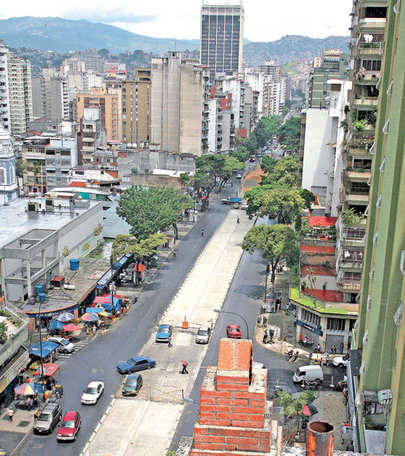
Las fechas siempre cambian, y al parecer llevan desde el 2001 pensando en Bus Caracas. En 10 años cambio Bogota... en 9 años aun no se ve el primer Autobus.
Los trabajos se ven más en la Av. Fuerzas Armadas.
Credito: CARLOS RAMÍREZ


buscaracas.jpg


Articulo: Concejales discuten plan de movilidad para Caracas


Foto: Pablo Corral

El presidente de la Comisión de Transporte y Vialidad del Cabildo Metropolitano, Alejandro Vivas,se reunió este miércoles con concejales de los municipios Libertador, Baruta, El Hatillo y Sucre para discutir el proyecto de ordenanza Plan Caracas en Movimiento.

En la primera mesa de trabajo sobre el proyecto de movilidad en el Concejo Municipal de Baruta, en Las Mercedes, Vivas planteó la coordinación conjunta de los cinco municipios para consultar con los concejos municipales de Caracas y del estado Miranda propuestas y modificaciones del proyecto.

En una segunda etapa se realizará una consulta con los institutos de transporte y vialidad de los diferentes municipios y sus síndicos procuradores para aportar ideas para el plan de movilidad caraqueño.

El concejal metropolitano señaló que la tercera consulta se realizará con el Ministerio de Infraestructura (Minfra), el Instituto Nacional de Transporte Terrestre (INTT) y con el Metro de Caracas.

En la etapa final se planteó un diálogo con los ciudadanos prestadores de servicios de transporte
, que incluye transportistas, taxistas y motorizados. Tras escucharlos se conversará con los usuarios del servicio, concejos comunales, mesas de transporte, asociaciones de vecinos, ciudadanos y estudiantes.

La concejala María Auxiliadora Dubue, presidenta de la comisión de Seguridad y Control de Gestión del Concejo Municipal de Baruta, afirmó que en el Área Metropolitana de Caracas “hay mucha desorganización”.

Dubue señaló que al proyecto de movilidad hay que darle forma legislativa. “También se debe incluir una normativa en materia de policía vial. Con ayuda del Minfra se debe redactar el plan de movilidad. No podemos sacar una ordenanza que luego sea imputada. Me comprometo a analizarla para hacer las modificaciones respectivas. Debemos sacar una ordenanza general y las especificidades deben estar reguladas por cada municipio”, informó.

La presidenta de la comisión de Seguridad afirma que deben ser escuchados los ciudadanos que están a favor y en contra del plan de movilidad para hacer un análisis y presentar una propuesta que beneficie a todos.

Por la bancada oficialista el concejal de El Hatillo, Iván Machado, apoyó que la iniciativa de la Alcaldía Metropolitana se analice con todos los sectores.

“La exposición de motivos es muy interesante y entiendo que lo que se asoma es un plan Pico y Placa“, dijo Machado.

“Con estas medidas los ciudadanos buscan adquirir otro auto. Todo debe ir en función de mejorar el transporte público superficial para que los conductores dejen sus vehículos y utilicen unidades dignas“, agregó.

Machado propone hacer uso de bicicletas en zonas planas con vías especiales para evitar accidentes de tránsito. También planteó agregar al Plan Caracas en Movimiento un reglamento de uso de las motos, camiones y bicicletas en horas pico”.

Eduardo Battistini, presidente del Concejo Municipal de El Hatillo, afirma que se debe defender el plan Pico y Placa con acuerdos mancomunados en bacheo, señalización y mejoras en la vialidad.Propuso realizar una mesa de trabajo con el Minfra para mejorar la movilidad en las autopistas.

Los delegados del municipio Libertador, Manuel Silva y José Hernández, autorizados por el concejal Francisco Avile de la comisión de Transporte, Vialidad y Servicios del ayuntamiento capitalino, vieron con preocupación que se están estableciendo planes de movilidad en ejes de Caracas que son competencia del Instituto Nacional de Transporte Terrestre (INTT).

Hernández dijo que en Libertador desarrollan el Buscaracas para mejorar el entorno urbanístico y el transporte público. “Allí tenemos concordancia. Debemos crear un puente de comunicación para solucionar el problema de movilidad. Reconocemos que el alcalde metropolitano tiene potestad para crear ejes de movilidad como el INTT“.

El representante dijo que en Libertador se aprobó en primera discusión un plan de regulación para mototaxistas y ordenanzas para el transporte. “Los vamos a presentar a los cinco municipios para ayudar”, dijo.

Jorge Hernández

El Universal


ARTIculo: Ledezma anuncia plan "Caracas en movimiento

01:38 PM Caracas.- El Alcalde Metropolitano, Antonio Ledezma, anunció hoy un proyecto de ordenanza que busca resolver el problema del tránsito en Caracas y que ya fue recibido en la Cámara Metropolitana.


"No se está hablando de un pico y placa o de una administración del tránsito. Estamos hablando de una política integral que va desde la infraestructura que tiene que ver con el bacheo, hasta un trabajo con los distribuidores", explicó.

Informó que en el "Plan Caracas en movimiento" se detallan obras de bacheo en sectores del municipio Sucre, Baruta e Intercomunal de Antímano. Así como un preacuerdo entre el alcalde Gerardo Blayde y el Alcalde Metropolitano de Caracas, para hacer una inversión conjunta y comenzar la construcción del distribuidor de El Placer. Inversión que superaría los 20 mil millones de bolívares.

"El proyecto ya está elaborado, están listos los detalles del proyecto. También se habla en el plan de otros distribuidores, como el de Hoyo de la Puerta, uno en la Trinidad vía hacia el Hatillo, también de otros nodos viales en le Municipio Libertador y Hatillo. Al igual que proyectos de puentes para conectar a la ciudad que está dividida por el río Guaire", argumentó

Alrededor de 81 ejes de movilidad van a ser incorporados en la nueva política de administración, que comprenden además mejoras de los semáforos, la demarcación y la participación de los sectores del transporte.

Diferencia entre Pico y Placa

Ledezma aseguró que el plan se diferencia del pico y placa porque "en primer lugar es un programa integral. No es un decreto sino una ordenanza que implica un debate en la Cámara Metropolitana, implica una consulta con transportistas, usuarios, representantes de concejales y de vecinos para que opinen sobre esta ordenanza", afirmó.

Ante la posibilidad de que la medida sea impugnada, como ocurrió con el pico y placa, explicó que al ser una ordenanza tiene un escenario jurídico diferente. "Nosotros estamos hablando de unos ejes de movilidad que están bajo la administración de la Alcaldía Metropolitana desde el punto de vista legal. No estamos asumiendo atribuciones que no nos están dadas en la ley nacional o metropolitana. Todo lo que estamos planteando tiene un marco legal que favorece estas iniciativas", dijo el alcalde.

La intención de la ordenanza es administrar 1700 mil vehículos y hacer una regulación para que no estén simultáneamente en las autopistas lo que, según Ledezma, va a producir resultados beneficiosos a corto y mediano plazo

BISA Reporte: Perfil en LinkedIN

Link

La presentación en PPT la vamos a poder montar en esta pagina....

DOCUMENTO: PLAN RECTOR CARACAS EN MOVIMIENTO